

Where Did Factory Owners Invest Their Money In The Industrial Revolution
Beginning in the 18th century, the Industrial Revolution was a defining period of western history. Although we commonly think of it as being the evolution from economies based on agriculture and handicrafts to ones primarily based on industry and machine manufacturing, it was in fact so much more than that.
The process affected almost every aspect of life, with profound social and cultural changes taking place alongside the economic and technological changes. Here are 10 facts about the Industrial Revolution.
1. It began in Britain
The Industrial Revolution is commonly seen as starting in Britain before spreading to other parts of the world. Already the world's leading commercial nation at the time, Britain's head start in the Industrial Revolution further fuelled its imperialist ambitions and led to it becoming the most powerful country in the world. By the 20th century, the British Empire was the biggest in history.

The walls of the new Postal Museum house five centuries of stories and secrets – not just about post, not just about stamps, but about the remarkable people who made the Royal Mail what it is today.
Watch Now2. It all started with coal
Britain sits on a lot of coal. But until the 18th century, wood had been the primary source of energy in the country. Coal, however, could produce up to three times more energy than timber, and as Britain's population grew and the demand for fuel increased so too did the demand for coal.
As coal mines grew deeper, they were at increased risk of flooding and people began to search for an effective way of pumping this water out. A steam engine was developed that could pump water from hundreds of metres below ground. Though highly inefficient fuel-wise, this machine enabled Britain to dig deeper and deeper for coal, giving it access to a seemingly endless supply of cheap energy.

In February 1882 the SS Dunedin departed New Zealand on a voyage that would revolutionise the way we eat and kickstart the globalisation of the world's food supply chain. Aboard were thousands of mutton, lamb and pig carcasses as well as 250 kegs of butter, hare, pheasant, turkey, chicken and 2226 sheep tongues. This cargo would be kept fresh in the ship's hold using a Bell-Coleman compression refrigeration machine and would mark the first time fresh goods had ever been transported over such a distance. However, the journey was far from plain sailing though as you will hear in this episode. To tell the Dunedin's story and to celebrate the new digitisation project by Lloyd's Register Foundation's Heritage & Education Centre Dan is joined by Charlotte Ward and Max Wilson from the Foundation.
Listen Now3. But coal wasn't the only factor
After all, Britain had had coal for millions of years. The unique intellectual climate in 18th century Britain was also an important factor. Unlike in many European countries, scientific ideas were not subject to censorship and the exchange of such ideas between thinkers enabled inventions like the steam engine to come about.
4. The term "Industrial Revolution" was popularised by an English economic historian
Mention of the term can be traced back to 1799 and it was even used by the co-founder of Marxist theory Friedrich Engels in his book The Condition of the Working Class in England in 1844. But it wasn't until 1881 that the term was popularised by the English economic historian Arnold Toynbee, who used it to refer to the economic development of Britain between 1750 and 1830 in lectures he gave that year.
Many historians now challenge Toynbee's ideas, however, putting the start of the Industrial Revolution much earlier and arguing that the change was more gradual than he suggested.
 Shop Now
 5. The first modern factory was a water-powered cotton spinning mill
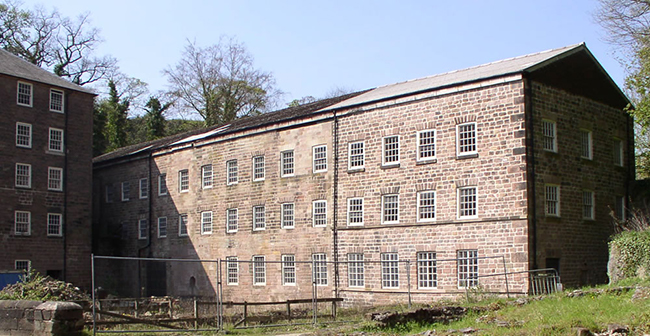
The factory was the world's first water-powered cotton spinning mill.
Established by a man named Richard Arkwright in 1771, the mill was located in the village of Cromford in Derbyshire. It initially employed 200 workers and ran day and night with two 12-hour shifts.
Many of the mill's workers were migrant labourers and the local area did not have enough housing to home them. To resolve this issue, Arkwright built housing for the workers nearby, becoming one of the first manufacturers to do so.
Today, the mill is a UNESCO World Heritage Site and open to the public.
6. There was a huge migration of people to towns and cities
In the mid-18th century, about 15 per cent of the English population lived in urban areas; by 1900 this figure had increased to a whopping 85 per cent.
7. Between 1815 and 1914, the production of materials and goods in Britain increased dramatically
Katie Wignall, founder of Look Up London, shines a light on the stories of Annie Besant, Annie Brewster and Sylia Pankhurst, several heroines who transformed London's East End.
Watch NowDuring these 100 years, the production of coal increased 20-fold, while the production of "pig" (crude) iron increased 30-fold. The output of textiles, meanwhile, increased by 15-fold.
8. The period of intense canal-building in the 1790s and 1800s is known as "Canal Mania"
During this time, huge sums of money were invested in building canals in Britain, though not all of the waterways proved profitable. By 1850, there were more than 4,000 miles of canals in the country. A similarly intense period of railway-building in the 1840s is known as "Railway Mania".
9. Britain's first railway line opened in 1825
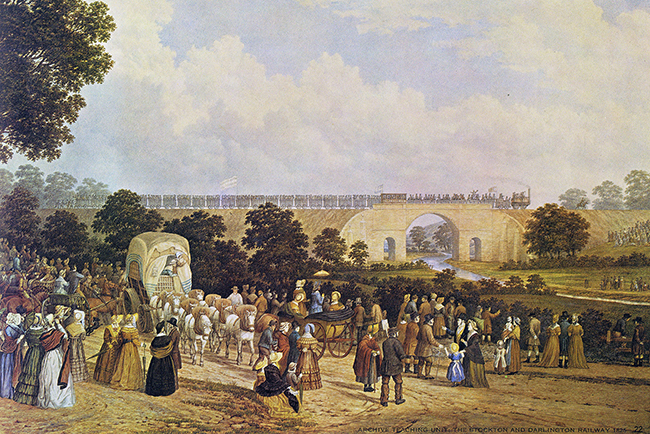
Crowds gather for the opening of the first Stockton and Darlington Railway line in 1825.
Built by the Stockton and Darlington Railway company, the 25-mile-long railroad connected collieries near the north English town of Shildon with the towns of Stockton-on-Tees and Darlington.
10. There was arguably a Second Industrial Revolution
In the latter part of the 19th century, a new set of innovations led to rapid economic growth – a phase that is often referred to as the "Second Industrial Revolution" or the "Technological Revolution". It followed an economic recession that struck at the end of the original Industrial Revolution in the 1830s and 1840s.
Where Did Factory Owners Invest Their Money In The Industrial Revolution
Source: https://www.historyhit.com/facts-about-the-industrial-revolution/
Posted by: johnsonhosly1963.blogspot.com
0 Response to "Where Did Factory Owners Invest Their Money In The Industrial Revolution"
Post a Comment